
Do Solar Panels Need Cleaning? A Florida Homeowner's Verdict

Updated: 2 days ago

Solar panels need cleaning when something is shading the cells that rain cannot rinse off. In Florida that describes most coastal homes, homes under oak or pine canopy, homes near farms or construction, and any low-tilt array. A steep, inland, tree-free roof often needs only an annual check, not a wash.
At a Glance
Dirt does not damage solar panels, but it can cut output by about 5% to 20% depending on what it is and where it sits.
Panel makers do not require scheduled cleaning; REC recommends cleaning "when dirt can clearly be seen on the glass surface."
The homes most likely to need cleaning on the Treasure Coast are barrier-island, riverfront, oak-shaded, and low-tilt installations.
A steep, unshaded array inland and away from farms and new construction may go a year or more without needing a wash.
Your monitoring app answers the question better than a look from the driveway: compare clear-day production month to month and panel to panel.
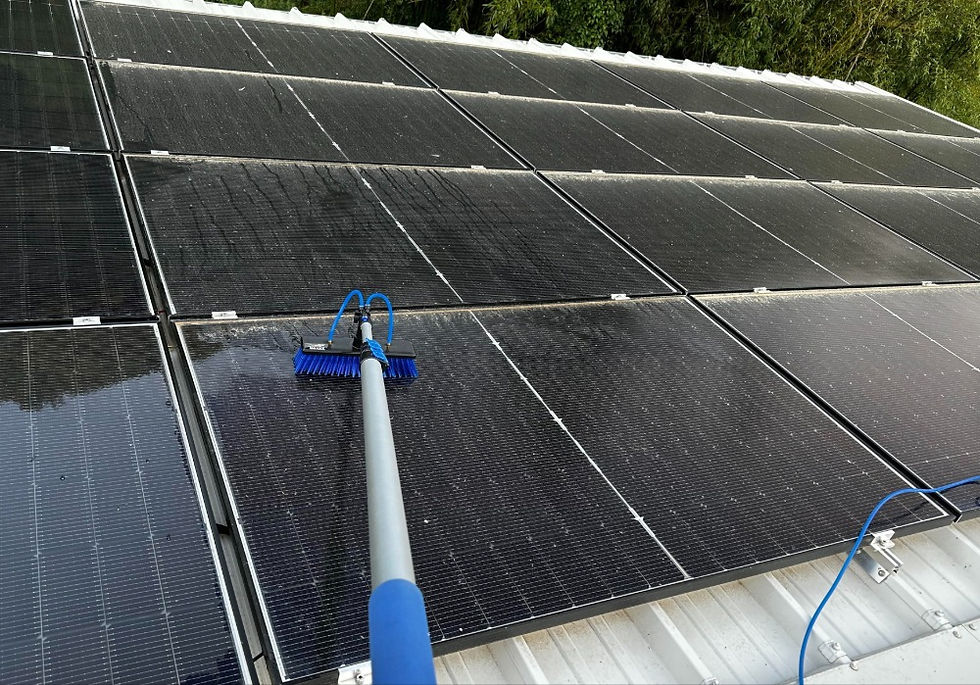
If you do clean, use soft brushes and pure water from the ground or hire a solar company; never a pressure washer.
Do solar panels need cleaning at all?
Yes, some do and some don't, and the deciding factor is whether soiling actually shades cells. Panel manufacturers design glass to shed dust in rain. Qcells' Q.TRON installation manual says dirt is "usually washed away by rain," then adds that a module shaded by dirt or debris such as bird droppings "needs to be cleaned to prevent a loss of performance." REC's cleaning guide says the same thing in different words: dirt will not harm the panel, but buildup affects performance, so clean when you can see it.
So the honest answer is conditional. Cleaning is maintenance for output, not maintenance for the equipment's survival. Skipping it will not shorten the life of the panel in most cases. It just costs you kWh, and on some Florida roofs that cost is real while on others it is close to zero. Rain helps less than most people think; we explain why in does rain clean solar panels.
Which Florida homes need solar panel cleaning?
The table below sorts common Treasure Coast home situations by how likely they are to need cleaning. It is a starting point; your monitoring data has the final word.
Home situation | Typical soiling | Likely needs cleaning? | Why |
Barrier island or oceanfront (Hutchinson Island, Jupiter Island, Vero barrier island) | Salt crust, sand, gull and pelican droppings | Yes | Salt re-forms with nightly dew and traps other dust; rain only resets it briefly |
Riverfront or near the Intracoastal, St. Lucie or Indian River Lagoon | Salt mist, bird droppings | Usually yes | Wading and roosting birds plus salt air |
Under or next to live oaks, laurel oaks, slash pine | Pollen film, sap, leaf debris | Yes, especially after spring | Spring pollen gets cemented by dew before the rainy season starts |
Near citrus groves, sod farms, horse property, cattle land (western St. Lucie, Fellsmere, Loxahatchee, Indiantown) | Field dust, fertilizer dust | Yes | Fine dust and organic film arrive on every dry, windy day |
Near new construction, unpaved roads, or a busy highway (I-95, Turnpike, US-1) | Concrete dust, diesel soot, lovebugs during flights | Often | Fine particles plus insect residue during spring and late-summer flights |
Flat, low-slope, or flush-mounted array (commercial, condo, lanai roof) | Mud line along the lower frame, pooled dirt | Yes | Water pools instead of running off, so rain deposits dirt instead of removing it |
Steep roof (6:12 or steeper), inland, no overhanging trees | Light road dust | Often no | Rain sheets off fast; an annual visual check is usually enough |
Ground mount in an open yard | Mower clippings, sprinkler spots, sand | Sometimes | Easy to inspect and spot-clean from the ground |

Which homes can usually skip cleaning?
Homes that can usually skip routine cleaning share four traits: a roof pitch of roughly 6:12 or steeper, no overhanging trees, an inland location at least a few miles from salt water, and no farms, unpaved lots, or active construction nearby. A newer subdivision in western Port St. Lucie or Tradition with young landscaping often fits this profile.
Even these homes should get one look a year. A single bird dropping over a cell or a palm frond stuck against the frame is a shading problem, and rain will not move either. The goal is not to clean on a calendar. It is to check, and clean only when the check says so.
How do I know if my solar panels need cleaning?
You know your panels need cleaning when production on clear days drops for no other reason, or when you can see soiling that covers part of a cell. Two checks answer the question in under 15 minutes, and neither requires a ladder.
Check from the ground
Pick a bright morning and stand where you can see the array at an angle, not straight on. Low-angle light shows film and streaks that look invisible face-on.
Use binoculars or your phone's zoom. Look for white spots (droppings), a brown band along the lower frame (mud line), a yellow-green haze (pollen), or a dull, frosted look (salt).
Look under the array edges for leaves, nesting material, or pigeon activity.
Take a photo each time you check so you can compare season to season.
Do not climb onto the roof to look. Wet panels, barrel tile, and metal roofs are slippery, and panels are not designed to be stepped on. Our post on whether it is safe to clean solar panels yourself explains the risks.
Check your monitoring app
In the Enphase, Tesla, or inverter app, find two clear, cloud-free days about a month apart in the same season.
Compare daily kWh. A steady slide on sunny days, with no new shade from a growing tree and no error alerts, points to soiling.
If you have panel-level data (Enphase microinverters show every panel), compare panels on the same roof face. Panels that trail their neighbors by a consistent margin usually have droppings, debris, or a mud line.
Check the year-over-year view for the same month. A gap bigger than normal aging (well under 1% a year for modern panels) is worth a look.
Our sibling post on solar app signs your panels need cleaning walks through these screens step by step.
What happens if you never clean your solar panels?
If you never clean solar panels on a Florida roof that collects bonded soiling, output drifts down by roughly 5% to 20% and stays there, and stubborn spots get harder to remove. Bird droppings and lichen-like growth on low edges can shade the same cells for months, and partially shaded cells run hotter than their neighbors. That uneven heating is how small soiling problems turn into hot spots, a topic we cover in depth elsewhere in this series.
On a clean, steep, inland roof, "never" may cost very little. That is why the right answer starts with a check, not a schedule.
Is cleaning worth the cost?
Cleaning is worth it when the production you recover is worth more than the cleaning. You can run that math with your own numbers:
Find your annual production in the app (for example, a figure in kWh for the last 12 months).
Multiply by the soiling loss you suspect: 5% for light dust, closer to 10% to 20% for droppings, pollen film, or a mud line.
Multiply that kWh figure by your FPL rate from your bill.
Compare the result to a typical residential cleaning, which runs about $249 to $500 with us.
Larger systems, heavier soiling, and higher electric rates tip the math toward cleaning. A small system with light dust may not pay back. Our post on solar panel cleaning cost in South Florida breaks down what moves the price.
What cleaning will not fix
Cleaning will not fix low production caused by new shade, inverter or microinverter faults, a tripped breaker, a failed connector, or normal panel aging. If your panels look clean and production is still down, the problem is electrical or environmental, not dirt. In that case a maintenance visit or inspection is a better use of the money than a wash.

The Bottom Line
Do solar panels need cleaning? In Florida, coastal, tree-shaded, farm-adjacent, and low-tilt arrays usually do, because salt, pollen, droppings, and mud lines bond to the glass. Steep, inland, unshaded arrays often don't. Check once or twice a year from the ground and in your app, and clean only when you see shading soiling or an unexplained drop. How often to repeat that is a separate question we answer in how often to clean solar panels in Florida.
Frequently Asked Questions
Does cleaning solar panels void the warranty?
Cleaning itself does not void a panel warranty, but cleaning the wrong way can. REC states that pressure washers, steam cleaners, knives, blades, and metal sponges are not permitted and will invalidate its warranty. Qcells says damage caused by cleaning methods or tools is not covered. Soft brushes and pure water stay within both manufacturers' guidance.
Do new solar panels need cleaning?
New panels need the same check as older ones. A brand-new array can pick up construction dust from the install, roof work, or neighboring builds in the first few months. Look at your app after the first dry season; if clear-day output slides without a shade or equipment reason, the glass is the likely cause.
Do Enphase or Tesla apps tell you when to clean?
Most monitoring apps do not send a "clean me" alert. They show production and flag equipment errors, so soiling shows up only as a slow decline. Panel-level systems such as Enphase make it easier, because a dirty panel trails its neighbors on the same roof face on every sunny day.
Do panels on a metal roof need less cleaning?
Metal roofs shed water quickly, so the roof around the array stays cleaner, but the panels themselves soil the same way they would on shingle or tile. The panel frame still traps a mud line on low pitches, and salt, pollen, and droppings still bond to the glass. Pitch and location matter more than roofing material.
Can a dirty panel damage itself?
Light, even dust will not damage a panel. Concentrated soiling is different: a dropping or leaf that shades part of one cell for months can make that cell run hotter than its neighbors. Bypass diodes limit the effect, but persistent partial shading is the soiling situation most worth fixing promptly.
Not Sure Which Group Your Home Is In?
We clean and service arrays across Martin, St. Lucie, Indian River and Palm Beach counties, including systems we did not install. If you want a second opinion before paying for a cleaning, send us a screenshot from your monitoring app and a photo from the driveway and we will tell you honestly whether it is dirt. Learn more about solar panel cleaning on the Treasure Coast, call (772) 232-6594, email sales@blueenergyelectric.com, or reach us through our contact page.


Comments