
How Much Power Do Dirty Solar Panels Lose?

Updated: 2 days ago

Dirty solar panels typically lose 5% to 20% of their output, and where the dirt sits matters more than how much there is. An even film of dust on a Florida roof usually costs a few percent. A bird dropping, a mud line along the bottom frame, or a clump of oak leaves can cost far more because it blocks whole cells and trips the panel's bypass diodes.
Key facts at a glance
Soiling costs an estimated 3% to 5% of global annual PV energy production, according to the IEA PVPS Task 13 soiling report.
UC San Diego researchers found panels that went 145 days without rain or cleaning in a California summer lost only 7.4% of their efficiency (UC San Diego).
A dirt band covering just 0.5% of a module's area along its bottom edge caused a 9% power loss in a 2021 study published in Frontiers in Energy Research.
Most residential panels have three bypass diodes, so one fully blocked cell can switch off roughly one third of that panel.
On an Enphase microinverter system, a dirty panel only drags down itself; on a string inverter without optimizers, it can pull down the whole string.
In a South Florida summer, heat often costs more output than dirt: at a temperature coefficient of -0.34% per °C, a panel at 65°C makes about 13.6% less power than it would at 25°C, clean or dirty.
Why Where the Dirt Sits Matters More Than How Much
Soiling comes in two types: uniform soiling, which dims every cell evenly so output drops in proportion, and concentrated soiling, which blocks a few cells heavily and gets amplified by the panel's wiring.
Uniform Soiling: The Thin Film
Uniform soiling is the light gray film of dust, pollen, and salt residue that builds up between rains. On the Treasure Coast it usually includes fine salt from ocean spray on barrier-island and Intracoastal homes, spring oak pollen, and summer Saharan dust. Because every cell loses about the same amount of light, the panel keeps working normally at a slightly lower level.
Concentrated Soiling: Droppings, Edge Lines, and Leaves
Concentrated soiling is anything that covers part of a panel heavily: bird droppings, lovebug splatter in May and September, a wet leaf mat under a live oak, or the dirt line that forms along the lower frame. A field study in Western Rajasthan, India measured output losses of up to 23.8% from accumulated bird droppings on flat-mounted modules, because one dense dropping can block most of a cell (Impact of bird dropping deposition on PV module performance). Florida rain washes off loose dust but rarely dissolves dried droppings, which is why we explain the limits in does rain clean solar panels.

Why Does Partial Soiling Hit Harder?
Partial soiling hits harder because solar cells inside a panel are wired in series, so the weakest cell limits the current of every cell in its group. A typical 60-cell or 120-half-cell residential panel is split into three sub-strings, each protected by one bypass diode (PVEducation).
How Bypass Diodes Turn One Dirty Cell Into a One-Third Loss
A bypass diode is a one-way electrical detour that lets current skip a sub-string when one of its cells is badly shaded. The detour protects the shaded cell from overheating, but the whole sub-string stops contributing while the diode is active. The result: one dropping that fully blocks a single cell can remove about one third of that panel's power. Partly covered cells are worse in a different way, because the diode may not switch on and the weak cell can heat up, which is how soiling leads to the damage we cover in solar panel hot spots.
The Frame-Edge Dirt Line
The frame-edge dirt line forms when dew and light rain carry dust down the glass and leave it trapped against the lower aluminum frame. On panels mounted in portrait orientation, that band crosses the bottom row of cells in every sub-string at once. The 2021 Frontiers study measured a 9% loss from a band covering only 0.5% of module area on a low-tilt site, which shows how a thin strip of grime can outweigh a dusty surface.
How Your Inverter Type Changes the Loss
Your inverter type decides whether a dirty panel costs you one panel's output or a whole row's.
System type | What a heavily soiled panel does | Typical Florida example |
Microinverters (Enphase IQ8, IQ7+) | Only that panel loses output; neighbors are unaffected | Most systems we install |
String inverter with optimizers (SolarEdge) | Only that panel loses output; optimizer isolates it | Common on older Treasure Coast systems |
String inverter, no optimizers (SMA, Fronius) | The whole string can drop toward the weakest panel's current | Older or budget installs |
Tesla Solar Inverter with MCI devices | String-level design; partial soiling can affect the string [VERIFY with Tesla documentation] | Tesla solar roofs and panels |
What Does the Research Say About Soiling Losses?
Research agrees that soiling losses depend mostly on climate, rainfall, and tilt, and that humid, rainy regions like Florida sit at the low end for uniform dust. The table summarizes the studies most often cited.
Source | Finding | What it means in Florida |
NREL soiling map, 83 U.S. sites (OSTI) | Highest losses in the arid Southwest, especially Southern California | Florida is not a high-dust region for uniform soiling |
IEA PVPS Task 13 (2022) | 3% to 5% of global annual PV energy lost to soiling | Global average, skewed upward by deserts |
UC San Diego (2013) | 7.4% loss after 145 dry summer days; cleaning a 5 kW system mid-summer gained about $20 | Uniform dust alone rarely pays for a professional wash |
Frontiers in Energy Research (2021) | 0.5% bottom-edge coverage caused 9% power loss | Edge lines and concentrated grime matter more than area |
Bird-dropping field study, Western Rajasthan | Accumulated droppings cut module output by up to 23.8% at 0° tilt | Coastal birds and roosting pigeons are a real Florida cost |
The practical takeaway is that a frequently rained-on Treasure Coast roof usually loses little to plain dust, while concentrated soiling explains most of the double-digit losses we measure. Our allowed planning range for South Florida systems remains 5% to 20%, with the high end driven by droppings, edge lines, mold, and salt crust.
Does Cleaning Solar Panels Increase Efficiency?
Cleaning solar panels increases output only by the amount of light the dirt was blocking. It does not raise the panel's rated efficiency, fix wiring, or cool the panel. If soiling was costing 3%, a cleaning returns about 3%; if a dropping had switched off a sub-string, a cleaning can return a third of that panel's output the same day. Cleaning also cannot fix Florida's biggest routine summer loss, heat: at -0.34% per °C (Q.TRON) a panel at 65°C, a typical August roof temperature, makes about 13.6% less than at 25°C, so a July dip is usually heat and afternoon clouds, not grime.
How to Estimate Your Own Soiling Loss From the App
You can estimate your own soiling loss by comparing clear-sky days and comparing panels on the same roof plane. The short version:
Pick a cloudless day now and a cloudless day from the same week last year.
Compare total daily kWh; a gap of more than about 5% with no new shade or fault points to soiling.
On Enphase, open the Array view and compare panels on the same roof face; a single low panel near a roofline or tree usually means droppings or debris.
Re-check two or three clear days after the next heavy rain or cleaning to confirm.
The full step-by-step method, including Tesla and SolarEdge apps, is in how to tell if solar panels need cleaning from your app. If the numbers point to a fault rather than dirt, start with why is my solar production low.
When Is Cleaning Not Worth the Money?
Cleaning is not worth the money when the only problem is a light, even film of dust on a steeply tilted roof that gets regular summer rain. The math explains why. A typical 8 kW system on the Treasure Coast produces roughly 11,000 kWh a year [VERIFY with NREL PVWatts for the address]. A 3% soiling loss is about 330 kWh, worth roughly $45 to $55 a year at typical FPL residential rates [VERIFY current FPL rate]. A professional cleaning at $249 to $500 does not pay back on that alone.
Cleaning is worth it when:
Monitoring shows a loss of 8% to 10% or more on clear days, or one or more panels well below their neighbors.
Droppings, lovebug residue, mold, or a visible edge line are present (these do not rinse off in rain).
Your roof is low-slope or flat, where water pools and dirt bakes on.
You live on the barrier island or the Intracoastal, where salt film builds faster.
The cleaning is paired with an inspection, so loose wiring, rodent damage, or cracked glass gets caught early.
Our cost breakdown is in solar panel cleaning cost in South Florida. We would rather tell you to skip a wash than sell one your monitoring cannot justify.
Frequently Asked Questions
How often should Treasure Coast panels be checked for soiling?
Checking monitoring once a month takes five minutes and catches most soiling problems early. We recommend a professional cleaning every 6 to 12 months for most Martin, St. Lucie, and Indian River County homes, with the shorter interval for coastal, low-slope, or tree-shaded roofs where droppings and salt build faster.
Can dirty panels damage themselves, or only lose power?
Dirty panels mostly lose power, but concentrated soiling can cause damage. A dropping or leaf that partly covers a cell can force that cell to heat up instead of producing power. Over months this can brown the cell or scorch the backsheet, which is a hot spot and a possible warranty issue.
Will a garden hose fix the problem?
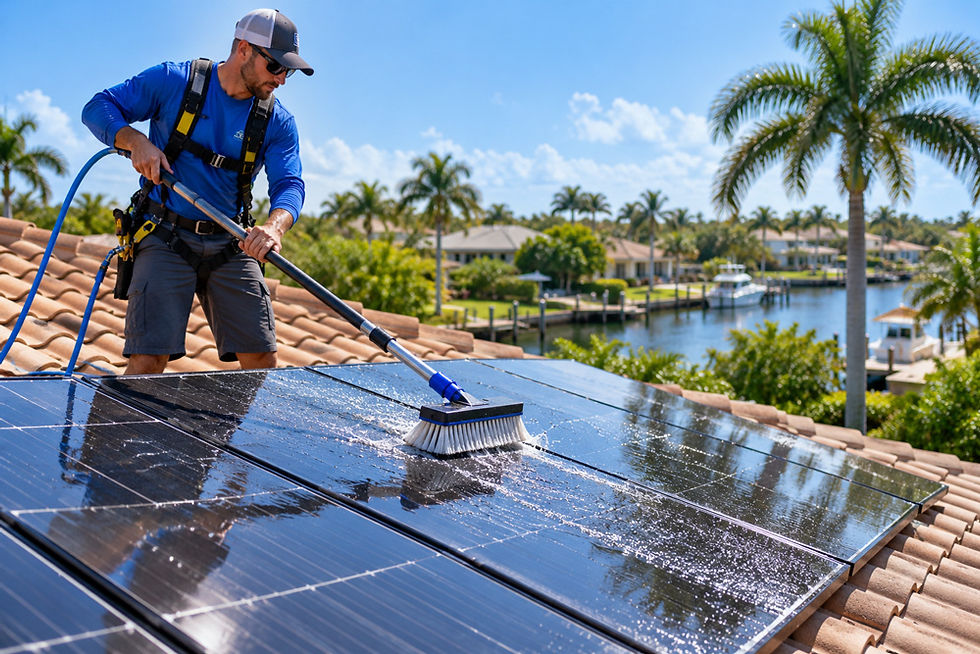
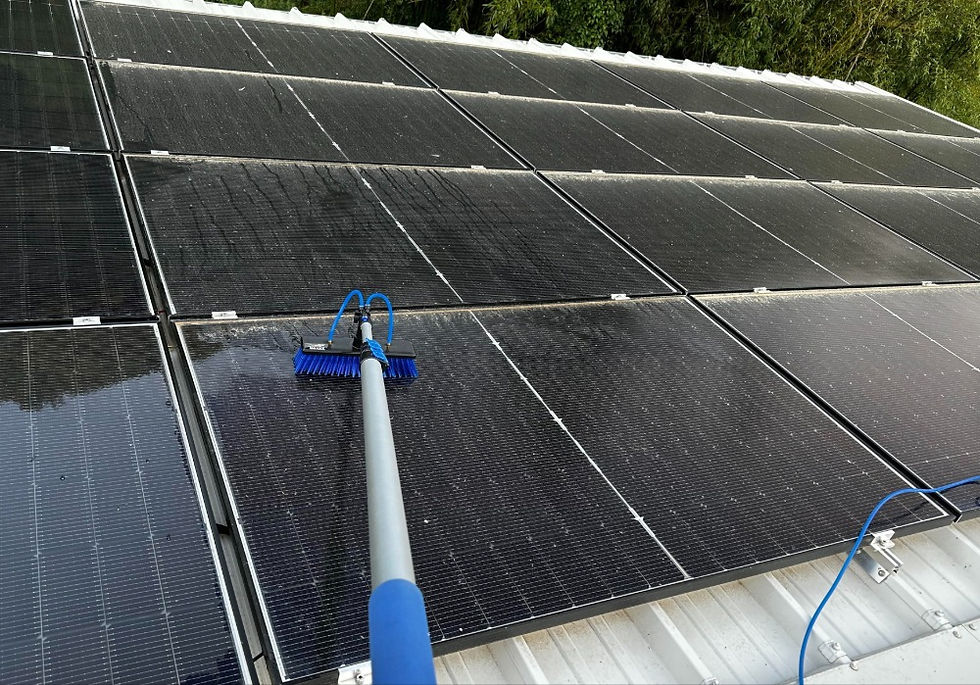
A garden hose rinses loose dust and pollen but rarely removes dried droppings, salt crust, or mold, and Florida's hard water can leave mineral spots. We use deionized water and soft brushes and never pressure washers. Climbing a wet roof is the bigger risk, so most homeowners should rinse only from the ground.
Does a dirty panel void my warranty?
Normal dirt does not void a panel warranty, but damage caused by neglect or by improper cleaning can be excluded. Pressure washers, abrasive pads, and harsh chemicals are common exclusions in manufacturer manuals. Keeping cleaning records and using soft, non-abrasive methods protects your claim if a defect appears later.
The Bottom Line on Dirty Solar Panel Power Loss
How much power dirty solar panels lose depends on the type of dirt: an even dust film costs a few percent, while droppings, edge lines, and leaves can cost 10% to 20% or more on affected panels. Check your app before paying for a wash, and clean when the numbers or the droppings say so.
If your monitoring shows a gap you cannot explain, our in-house team can clean, inspect, and test your system in one visit. See our Treasure Coast solar panel cleaning service, or our solar maintenance and repair team if it looks like more than dirt, including solar repair in Martin County. Call (772) 232-6594, email sales@blueenergyelectric.com, or contact us Monday through Friday, 9 to 5.


Comments