
Does Rain Clean Solar Panels? What Florida Rain Leaves Behind

Updated: 2 days ago

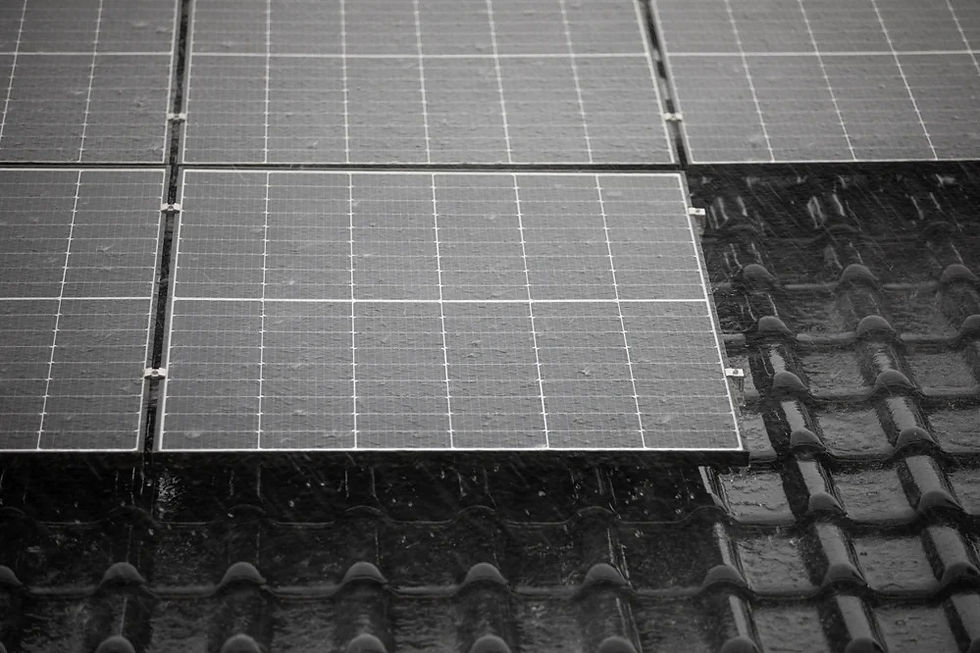
Rain cleans solar panels only partly. A heavy Florida downpour rinses loose, dry dust off a tilted array, but it does not remove bonded films: pollen that dew has glued down, bird droppings, salt crust, lovebug residue, or the mud line that forms along the bottom frame. Those need a gentle hand wash with soft brushes and pure water.
At a Glance
Rain removes loose dust and some fresh pollen, mainly on panels tilted at a normal roof pitch.
Rain does not dissolve bird droppings, cemented pollen, salt crust, or dried insect residue.
South Florida's rainy season runs roughly May 15 to October 15; the dry season from November to May is when soiling builds up.
Low-tilt and flush-mounted panels collect a "mud line" along the lower frame edge that rain makes worse, not better.
Soiling can cut a system's output by about 5% to 20%, depending on what is on the glass and where.
Your monitoring app is the best test: if production does not recover after a big storm, rain did not fix it.

What happens to solar panels when it rains?
Solar panels keep producing a little power under rain clouds, and the water does the sealed, outdoor-rated glass no harm. The cleaning effect depends on how hard it rains and how steep the panels sit. A short, heavy cell (the typical 3 p.m. summer storm in Port St. Lucie or Stuart) sheets water down the glass fast enough to carry loose grit off the bottom edge.
A light drizzle does the opposite: it wets the dust, then the sun bakes it back down as a thin film. REC, one of the panel brands we install, says in its installation manual that "normal" rainfall will clean panels only "if installed at a sufficient angle to ensure water runs off the surface," and that the lower the angle, the more cleaning is needed.
What kind of dirt does rain actually wash off?
Rain washes off soiling that is dry, loose, and not chemically stuck to the glass. On Treasure Coast roofs that usually means:
Road and construction dust that settled in the last few days
Fresh, dry pollen that has not been through a dew cycle yet
Light sand blown in from the beach or a nearby lot
Small leaf fragments and oak tassels that are not wedged against the frame
If your array sits on a normal 4:12 to 6:12 shingle or barrel tile roof (about 18 to 27 degrees of tilt), a strong storm will clear most of this. That is the part of the rain myth that is true.
What does Florida rain leave behind?
Rain leaves behind anything that has bonded to the glass. The table below covers the soiling types we see most often across Martin, St. Lucie, Indian River and Palm Beach counties.
Soiling type | Where it's worst | Does rain remove it? | Why not |
Oak and pine pollen film | Neighborhoods with live oaks, laurel oaks, slash pine | Partly, only when fresh | Dew turns it into a sticky film that dries onto the glass |
Bird droppings | Near water, docks, palms, power lines | No | Droppings dry hard and shade whole cells; rain just rewets the edges |
Salt crust | Hutchinson Island, Jupiter Island, Jensen Beach, Vero barrier island | Partly | Salt draws in moisture overnight and re-forms as a crust each morning |
Lovebug residue | Near highways and open lawns during spring and late-summer flights | No | Insect bodies dry onto glass and break down into an acidic film |
Saharan dust | Region-wide, summer | Partly | Fine mineral dust settles between storms and mixes with humidity |
Mud line at the lower frame | Low-tilt, flat and flush-mounted arrays | No, rain makes it worse | Runoff carries dirt down and leaves it where water pools at the frame lip |
Hard-water and sprinkler spots | Arrays near well-water irrigation | No | Minerals stay behind when water evaporates |
Bird droppings deserve special mention because a single dropping can shade a cell completely, and shaded cells can heat unevenly. We cover that in detail in our post on bird droppings and solar panel damage.
Why does dew make Florida soiling harder to rinse?
Dew glues dust to solar glass. Panels radiate heat to the night sky and drop below air temperature, so on humid Treasure Coast nights they are often the wettest surface on the roof by sunrise. Researchers call what happens next cementation: the dew dissolves the soluble part of the dust, then morning sun dries it into a crust that sticks far harder than the original dust. The International Energy Agency's PV program summarizes this dew and humidity effect in its report on soiling losses.
Florida gets heavy dew most of the year, including the dry months. That means a dry-season pollen layer can go through dozens of wet-dry cycles before the first real rainy-season storm arrives. By then it is no longer loose pollen. It is a film. Our post on how Florida pollen affects solar panel performance explains why that yellow-green haze costs more production than it looks like it should.
Does the Florida rainy season clean panels enough?
The rainy season helps, but it arrives after the dirtiest months. The National Weather Service office in Miami defines South Florida's rainy season as roughly May 15 to October 15, when the majority of the year's rain falls. The rest of the year is the dry season.
That timing works against solar owners in three ways:
Soiling peaks in the dry season. UF/IFAS notes that oak pollen peaks in South Florida from about February to May, exactly when rain is scarce.
Spring is high-production season. Clear skies and a high sun make spring some of the strongest production months on the Treasure Coast, so a dirty array costs the most kWh right when rain is least likely to help.
Summer adds new soiling between storms. NOAA says Saharan dust outbreaks peak from late June to mid-August and can reach Florida. Dust settles on dry days, and dew starts cementing it again.
Under FPL net metering, surplus kWh from spring carry forward as credits on your bill, so lost spring production is lost credit you would otherwise use against summer air-conditioning. If you want to time a cleaning around these seasons, our guide to the best time to clean solar panels in Florida has a month-by-month table.
Why do low-tilt panels get a mud line after rain?
Low-tilt panels get a mud line because rainwater runs to the lower edge, stalls against the aluminum frame lip, and evaporates there. Every storm carries a little more dirt down the glass and drops it in the same strip. Over a few months that strip becomes a brown band 1 to 3 inches tall along the bottom row of cells.
The mud line matters more than its size suggests. Panels wire their cells in series groups, so shading the bottom row can drag down output from cells that are perfectly clean. We see it most on flat commercial and condo roofs, low-slope lanai roofs, and panels on the shallow faces of hip roofs.
Metal roofs shed water fastest, but the panel itself still has a frame lip, so standing-seam metal does not prevent the mud line. Barrel tile roofs add a different problem: tile dust and granules from aging tile ride the runoff onto the array below.

Does salt air make rain less effective near the coast?
Salt air makes rain less effective because salt keeps coming back. On barrier-island and riverfront homes, onshore wind deposits a fine salt mist that is hygroscopic: it pulls moisture out of humid air at night and forms a crust by morning. A storm rinses some off, and a week of sea breeze puts it back, along with the dust it traps. Our post on salt air effects on solar panels on the Treasure Coast covers what that does to frames and hardware over time.
Can rain ever make solar panels dirtier?
Rain can make panels dirtier in two common Florida situations. Light rain after a dusty spell (including a Saharan dust event) wets the dust without moving it, and the water spots dry into a speckled film. Sprinkler overspray and runoff from a dirty roof section above the array leave mineral spots and grime that were not there before. In both cases the panel looks "washed" from the street but reads lower in the app.
How can you tell whether rain cleaned your panels?
Your monitoring app tells you more than a look from the driveway. Compare two clear, sunny days: one shortly before a heavy storm and one shortly after.
Open your app (Enphase, Tesla, or your inverter's portal) and pick two cloud-free days within about a week of each other.
Compare total daily kWh. If production jumps noticeably after the storm, loose dust was the problem and rain handled it.
If production barely moves, or one or two panels still lag their neighbors, the soiling is bonded and rain will not fix it.
With panel-level monitoring, look at the bottom row of an array. Panels that consistently trail the rest are often the ones with a mud line or droppings.
The Bottom Line
Does rain clean solar panels? On a steep Florida roof, a heavy storm rinses loose dust and nothing more. It does not remove dew-cemented pollen, bird droppings, salt crust, lovebug residue or the mud line on low-tilt arrays, and the rainy season arrives after the dry season has already done its damage. Check your app after a storm; if output does not recover, a gentle hand wash is the fix.
Frequently Asked Questions
Should I hose off my panels after a Saharan dust event?
A garden hose with normal household pressure is fine from the ground if you can reach safely, but tap water on the Treasure Coast is often hard and can leave spots. Rinse in the early morning, never at midday. If the dust has already been through a few dew cycles, a soft brush and deionized water work better.
Does rain clean solar panels on a flat roof?
Rain does very little for flat or near-flat arrays. Water pools instead of running off, then evaporates and leaves the dirt behind. Flat-roof and low-angle commercial arrays on the Treasure Coast usually need scheduled cleaning, because the mud line and droppings never get rinsed off naturally.
Will a hurricane or tropical storm clean my panels?
A tropical system dumps a lot of water, but it also throws leaves, sand, shingle grit and salt spray onto the array. After a storm, check the panels from the ground for debris, shifted panels or cracked glass before worrying about cleanliness, and never wet a panel that might be damaged.
How much power do dirty panels lose in Florida?
Soiling typically costs between 5% and 20% of output, depending on the type and location of the dirt. Loose dust sits at the low end. Bird droppings, a heavy pollen film, or a mud line across the bottom row of cells push losses toward the high end because they shade whole cells.
Get a Clear Answer for Your Roof
If your app shows production that never bounces back after a storm, rain is not going to solve it. Our in-house crews clean with deionized water and soft brushes (never pressure washers), and a typical residential cleaning runs about $249 to $500. See how we handle solar panel cleaning on the Treasure Coast, call our Stuart office at (772) 232-6594, email sales@blueenergyelectric.com, or send a note through our contact page. We are happy to look at your monitoring data with you first.


Comments