
Can You Pressure Wash Solar Panels? No, and Here Is Why

Updated: 2 days ago

You should not pressure wash solar panels. Both Qcells and REC rule out high-pressure water in their manuals, because it can strip the anti-reflective coating, push water past frame seals, stress the cells, and void the product warranty. Clean solar panels with soft brushes, low-pressure water, and ideally deionized water instead.
At a Glance
REC states that pressure washers, steam cleaners and high-pressure hoses are "not permitted" on its panels "and will invalidate the warranty."
Qcells manuals tell installers and owners not to use "any high-pressure water cleaning equipment."
A standard garden hose at household pressure is acceptable; a pressure washer typically puts out many times that force through a narrow tip.
High pressure can damage the anti-reflective coating, the frame-to-glass bond, the junction box seal, and the cells themselves through microcracks.
Roof "soft wash" chemicals, often bleach-based, are a separate risk: REC bans acidic or alkaline detergents on its panels.
The safe method is soft brushes, pure water at air temperature, and no standing on panels.
Can you pressure wash solar panels if you keep the wand far away?
No, distance does not make a pressure washer safe on solar panels. Pulling the wand back lowers the force at the glass, but you cannot measure that force, it spikes every time the tip swings closer, and the narrow jet still concentrates on small areas like frame corners and junction box edges. Manufacturers do not offer a "safe distance." They prohibit the equipment outright.
That matters on the Treasure Coast, where many barrel tile and shingle roofs get pressure washed for mildew. The machine is often already on the roof; the array is not part of that job.
What do solar panel manufacturers say about pressure washing?
Solar panel manufacturers say no in writing. Qcells and REC are two of the panel brands we install, and both manuals are public.
REC. REC's Quick guide to cleaning says a standard flexible garden hose "with domestic water pressure" may be used. It then says: "the use of high pressure hoses for cleaning is not permitted as these may exert pressure in excess of the certified load and cause impact damage, damage to the frame bonding, the laminate or cells and force water between the glass and frame." It adds: "The use of pressure or steam cleaners and high pressure hoses, knives, blades and metallic sponges is not permitted on REC panels and will invalidate the warranty." The REC Alpha Pure installation manual also requires cleaning while panels are cool and bans acidic or alkaline detergents.
Qcells. Qcells' installation manual for the Q.PEAK DUO XL-G10 series (North America, 2021) instructs owners to "Remove dirt with lukewarm water" and: "Do not use surfactants, rotating brushes, scrapers, or any high-pressure water cleaning equipment." The newer Q.TRON (BLK) M-G2.X manual warns that wrong cleaning can cause scratches, damage to the anti-reflective (AR) coating, delamination, and "loss of frame-to-laminate bond," and that damage caused by cleaning methods, tools or agents "shall not be covered by the module's Product and Performance Warranty."
For other brands, look up the installation manual by model number on the manufacturer's site.

How much pressure is too much for a solar panel?
Any pressure above normal household hose pressure is more than manufacturers allow. Residential water service typically runs around 40 to 80 PSI, and a garden hose with a gentle spray nozzle delivers a soft, wide flow. Consumer electric pressure washers are commonly sold in the 1,500 to 2,000+ PSI range, and gas units go higher, all focused through a narrow tip.
REC's explanation is the useful one: panels are tested to a certified load spread evenly across the whole surface. A pressure washer jet applies concentrated force to a small spot, which can exceed what that spot is built to handle even when the total force seems modest.
What does pressure washing actually damage?
Pressure washing damages five parts of a solar panel, and most of the damage is invisible on day one.
Anti-reflective coating. The glass on modern panels has a thin AR coating that lets more light reach the cells. A high-pressure jet carrying grit, salt crystals or sand acts like sandblasting. Coating loss is permanent and shows up as a duller, hazier surface and lower output.
Frame-to-glass seal. The bond between the aluminum frame and the laminate keeps water out of the panel edge. A jet aimed at that seam can push water in, which is exactly what REC warns about.
Junction box and connectors. The junction box on the back of each panel and the connectors under the array are rated for rain, not a directed jet. Water forced in leads to corrosion and, later, connection faults. Panels with microinverters underneath add more electronics in the spray path.
Cells (microcracks). Solar cells are thin silicon wafers under the glass. Concentrated force, especially on a panel that is flexing on its rails, can cause microcracks that do not show to the eye but reduce output and can grow into hot spots over time.
Backsheet. Spray from below can damage the polymer backsheet, which REC says to clean only gently by hand.
Florida adds two problems. Glass on a summer afternoon is hot, so a blast of cooler water risks thermal shock (REC notes panels run about 20°C above surrounding air while producing). And many pressure washers here run on well or hard municipal water, which leaves mineral spots that are harder to remove than the original dirt; see our post on hard water spots on solar panels.
Does pressure washing void a solar panel warranty?
Pressure washing can void a solar panel warranty, and for REC the language is explicit. Qcells' approach is slightly different: it lets owners choose a cleaning method but excludes damage caused by that method from warranty coverage. In practice the result is similar. If a claim inspection finds coating loss, seal failure or cracks consistent with pressure washing, you are likely paying for the replacement. Our post on whether cleaning voids a solar panel warranty covers what other cleaning mistakes can do to a claim.
Is soft washing safe for solar panels?
Soft washing is not automatically safe for solar panels. "Soft wash" usually means low pressure plus a cleaning solution, and roof soft-wash mixes in Florida are commonly based on sodium hypochlorite (the active ingredient in bleach) to kill mildew and algae on tile and shingle. Those solutions are strongly alkaline. REC says acidic or alkaline detergents "may not be used" on its panels, and Qcells warns against agents that affect any module component, including cables, connectors and silicone.
If your roof is being cleaned, ask the crew to avoid the array, rinse any overspray off the glass with plain water right away, and never walk on the panels. Our post on safe solar panel cleaning solutions lists what is acceptable on the glass.
What should you use instead of a pressure washer?
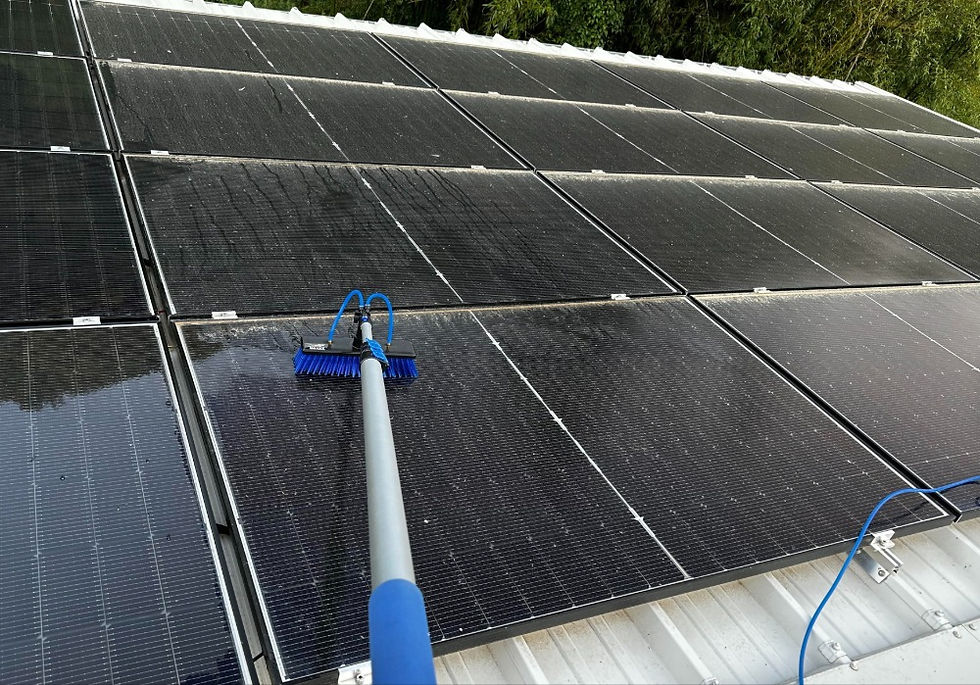
Use soft brushes, low-pressure water, and pure water. The method manufacturers describe, and the one we use, looks like this:
Inspect first. Check for cracked glass or damaged wiring before wetting anything. REC warns that damaged panels can present a shock hazard, and the risk is higher when they are wet.
Work cool. Clean in early morning or late afternoon, before or after the glass heats up, with water at air temperature.
Use deionized water. DI water has the minerals removed, so it dries without spots. REC names it as the preferred water.
Use soft tools. A soft-bristle brush, sponge, or microfiber on an extension pole. No scrapers, metal sponges, or rotating brushes.
Rinse with gentle flow from the top of the panel down, and let it air-dry or squeegee lightly.
Stay off the glass. Never stand on, kneel on, or rest a bucket on a panel.
For droppings or lovebug residue, soak the spot for a few minutes instead of adding force. For a do-it-yourself approach from the ground, our guide on how to clean solar panels in South Florida walks through it step by step.

How do pressure washing companies differ from solar companies?
Pressure washing companies that add "solar panel cleaning" can do good work, but a solar contractor treats cleaning as work on a live electrical system.
What to compare | Typical pressure-washing outfit | Licensed solar contractor |
Equipment on the array | Varies; some still use low-PSI pressure washers or roof soft-wash chemicals | Soft brushes, deionized water, no pressure washers |
Electrical knowledge | Not required | Licensed electrical and solar contractors who can spot loose wiring, damaged connectors, and failing microinverters |
What they inspect while up there | Usually just the glass | Glass, frames, racking, wiring, critter guards, roof penetrations |
If they find a problem | Refer you elsewhere | Can repair it, often on the same system history |
Warranty awareness | May not know manufacturer cleaning rules | Works to Qcells, REC and other manufacturer guidance |
Ask any company, including us, what equipment and water touch your panels, whether anyone will walk on them, and whether they carry insurance for rooftop work. Our list of questions to ask a solar panel cleaning company is a good checklist.
What if my panels were already pressure washed?
If your panels were already pressure washed, one wash does not mean they are damaged. Compare clear-day output in your app before and after the wash, and look from the ground for hazy patches or moisture inside the glass edge. If any panel trails its neighbors or you see fogging, have the system inspected so problems are documented early.
The Bottom Line
Can you pressure wash solar panels? No. Qcells and REC both rule out high-pressure water, and REC says it voids the warranty. The risks are coating loss, seal failure, water in the junction box, and microcracks, and Florida's hot glass and hard water make them worse. Soft brushes, cool glass and deionized water clean just as well without the risk.
Frequently Asked Questions
Is there a pressure washer that is safe for solar panels?
No pressure washer is approved by the major panel manufacturers we install. REC permits a garden hose at domestic water pressure and bans high-pressure hoses, pressure washers and steam cleaners. Qcells bans any high-pressure water cleaning equipment. A water-fed pole with a soft brush gives the same reach without the force.
Can I pressure wash my roof around the solar panels?
You can have the roof cleaned, but the panels, wiring, and connectors under the array should be kept out of the spray, and soft-wash chemicals should be kept off the glass. Ask the roof cleaner to work around the array and rinse any overspray off the panels with plain water right away.
Does Florida tap water damage solar panels?
Tap water does not damage solar panels, but hard Florida water and well water leave mineral spots as they dry, especially on warm glass. Those spots scatter light and can be harder to remove than the original dirt. Deionized water avoids the problem, which is why professional crews use it.
How much does professional solar panel cleaning cost?
Professional solar panel cleaning typically runs about $249 to $500 for a home with us, depending on panel count, roof type, access and how heavy the soiling is. Barrel tile and steep roofs take more setup time.
Clean Panels Without the Risk
We clean solar panels across Martin, St. Lucie, Indian River and Palm Beach counties with deionized water and soft brushes, and we never use pressure washers on the glass. Because we are also licensed electrical and solar contractors, our crew looks at wiring and hardware while they are up there. See how our Treasure Coast solar panel cleaning works, call (772) 232-6594, email sales@blueenergyelectric.com, or use our contact page.


Comments