
Rooftop vs. Ground-Mounted Solar: What’s Best for Your Commercial Property in Palm Beach County?

Updated: Nov 19, 2025

Choosing the right solar system for your commercial property is more than just a tech decision—it’s a strategic investment in your business's future. In Palm Beach County, where solar energy potential is high year-round, the question isn't if you should go solar—it's how.
At Blue Energy Electric, we specialize in helping businesses navigate this decision. Whether you're considering a rooftop system or a ground-mounted array, our local expertise ensures that your installation is optimized for performance, compliance, and long-term success.
Call us today at 772-232-6594 or contact us for a custom commercial solar assessment.
Why Go Solar for Your Commercial Property in Palm Beach County?
Florida ranks among the top states in the U.S. for solar potential, and Palm Beach County is no exception. With abundant sunlight and rising energy demands, businesses here are increasingly turning to solar as a means of cutting operating costs and reducing carbon footprints.
Commercial solar panel systems not only deliver consistent energy production but also enhance a company’s reputation for sustainability. And because energy prices tend to fluctuate, producing your own power ensures more stability and control.
With expert installation from Blue Energy Electric, your commercial building can become a self-sufficient energy producer. Our team delivers solar energy systems tailored to each property’s unique structure, orientation, and business goals.
What Is Rooftop Solar?

Rooftop solar systems are installed directly on your building’s existing roof. These are a common choice for commercial properties with large, flat roofs that can support solar panels without structural modification.
Benefits of Rooftop Solar:
No additional land needed – ideal for urban or space-constrained properties.
Lower visual impact – panels are typically out of sight from ground level.
Efficient use of existing space – especially beneficial for warehouses, offices, and retail stores.
Faster permitting and installation – in many cases, approvals come quicker than for ground systems.
Rooftop systems work especially well when the roof has optimal orientation (south-facing or flat), minimal shading, and solid structural integrity. According to a 2024 comparative study, rooftop systems can achieve a lower Levelized Cost of Electricity (LCOE) when conditions are ideal, making them a financially sound choice for many businesses.
However, rooftop solar does come with considerations. Maintenance can be more complex due to limited access, and the system’s performance is tied to roof angle and exposure. Structural issues such as aging or weight-bearing limitations may require adjustments or reinforcement—something our experts at Blue Energy Electric evaluate as part of our feasibility assessment.
What Is Ground-Mounted Solar?

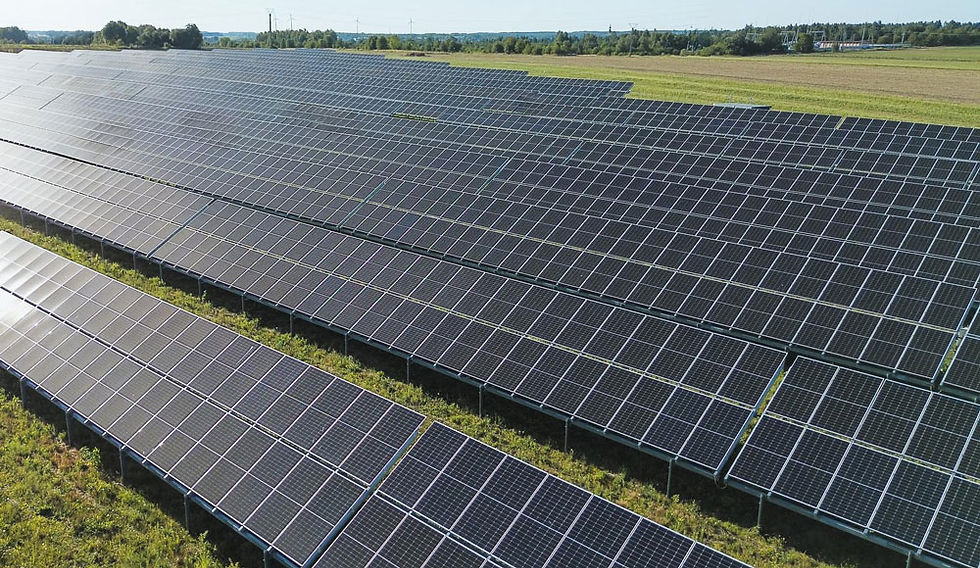
Ground-mounted solar systems are installed directly into the ground on racking systems, usually on open land adjacent to or near your property. This approach allows for total control over the system’s placement and angle, maximizing solar capture throughout the year.
Benefits of Ground-Mounted Solar:
Optimized orientation and tilt – for maximum energy production.
Easier access for maintenance and upgrades.
Flexible array sizing – great for larger energy loads or future scalability.
For businesses with available land, a ground-mounted array can outperform rooftop systems in overall efficiency. A study on PV configurations found that systems with optimized spacing and tilt can generate significantly more electricity than comparable rooftop systems.
Ground-mount systems are especially ideal for businesses with high energy consumption and expansive properties, such as agricultural, industrial, or logistics operations. They also offer the opportunity to implement dual-use land strategies, such as combining solar with landscaping or parking lot shading.
That said, ground-mounted solar systems may require additional permitting, land use approval, and site preparation. Installation depends on local zoning laws, soil conditions, and potential environmental impacts. Our team at Blue Energy Electric understands these challenges and ensures your system is compliant and efficient from day one.
Rooftop vs. Ground-Mounted: What’s the Best Fit?
There’s no one-size-fits-all answer. Choosing between rooftop and ground-mounted solar depends on multiple site-specific factors:
Feature | Rooftop Solar | Ground-Mounted Solar |
Space Use | Utilizes existing roof | Requires open land |
System Efficiency | Limited by roof angle and shading | Fully optimized orientation |
Maintenance Access | More limited | Easier and safer access |
Permitting Speed | Typically faster | May require more steps |
Visual Impact | Less visible | May need landscaping |
Structural Requirements | Depends on roof strength | Needs dedicated foundation |
Data from the National Renewable Energy Laboratory (NREL) shows that the performance and cost benchmarks for both systems are surprisingly close. This means that the best solution often comes down to property characteristics, energy goals, and long-term planning—not just efficiency alone.
Key Considerations in Palm Beach County
While both rooftop and ground-mounted systems offer excellent potential, businesses in Palm Beach County face unique regional factors that should guide their decision.
High Solar Irradiance
Palm Beach County enjoys high solar exposure year-round, making it one of the most solar-friendly regions in the U.S. Whether panels are installed on a roof or the ground, your system will benefit from consistent sunlight—maximizing energy output and return on investment.
Hurricane Preparedness
Commercial solar installations in South Florida must meet strict building codes due to the risk of hurricanes. This includes ensuring solar panel racking systems are rated for high wind speeds and that rooftop installations don’t compromise the building’s structural integrity. Ground-mounted systems, while easier to maintain, may also require anchoring or wind-resistant designs depending on the location.
Permitting and Zoning Regulations
Permitting can vary significantly across Palm Beach County municipalities. Rooftop solar installations typically move through the permitting process more quickly, as they don’t involve land use changes. Ground-mounted systems, on the other hand, may need zoning reviews, environmental assessments, or even neighborhood association approvals.
These complexities are why working with a local expert like Blue Energy Electric is essential. We handle permitting, code compliance, and engineering—so you don’t have to.
Structural Suitability
Commercial rooftops vary widely in terms of size, material, and age. Some may not be structurally suited to hold a solar system without reinforcement. Our team conducts full structural solar assessments before recommending a rooftop solution. For buildings where the roof is unsuitable, a ground-mounted system might offer better long-term performance and safety.
How to Choose the Right System for Your Business
Every commercial property has its own set of needs, challenges, and goals. The choice between rooftop and ground-mounted solar isn’t just technical—it’s strategic.
Ask These Questions:
Do you have enough open roof space? If so, rooftop may be ideal.
Is your building roof in good condition? If it's aging or shaded, consider ground-mount.
Do you have available land nearby? Ground-mounted solar could be a strong option.
How important is system expansion or future-proofing? Ground systems offer easier scalability.
Is minimizing visual impact a concern? Rooftop installations are more discreet.
Do you want to simplify the permitting process? Rooftop projects typically move faster.
As EnergySage points out, ground-mounted systems often yield higher energy output due to optimized positioning—but rooftop systems make the most of underutilized real estate and often face fewer permitting hurdles.
In the end, the choice is not about which option is universally better, but which is better for your site. That’s where a tailored feasibility study from Blue Energy Electric comes in.
Final Thoughts: Let’s Build Your Solar Strategy
Commercial solar systems—whether rooftop or ground-mounted—offer powerful benefits in Palm Beach County. With Florida’s excellent sun exposure, the right system can dramatically lower your utility bills, improve your brand image, and lock in long-term energy stability.
The decision isn’t one you need to make alone. At Blue Energy Electric, we guide Palm Beach County businesses through every stage of the solar journey—from system design and permitting to installation and long-term support.
Whether you're just starting your solar research or ready to move forward with a project, our team is here to help you make the most informed, strategic decision for your property.
Call us now at 772-232-6594 or contact us to schedule a free commercial solar consultation.
Or, learn more about your options at our commercial solar page.
Let’s build a cleaner, more efficient future—starting with your business.


Comments